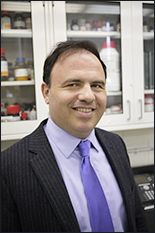
Kofinas Awarded Patent for Flexible Batteries
Year after year, hundreds of product and medical device fires attributed to batteries present risks for injury or even loss of life. That is because batteries most commonly used today in everything from electric toothbrushes to commercial aircraft are made primarily of a liquid electrolyte and containment layers. These containment layers play a critical role because the electrolyte itself is both toxic and corrosive when exposed to air. But, these containment layers add weight, cost, and mass. Recognizing these challenges, Fischell Department of Bioengineering (BioE) Professor and Associate Dean Peter Kofinas and Department of Chemical and Biomolecular Engineering (ChBE) alumnus Ayan Ghosh (Ph.D., ChBE ’09) set out a few years ago to develop a polymer solid electrolyte that would allow engineers to create safer batteries. Because the electrolyte itself is a polymer film, batteries featuring this novel conductor do not require the use of bulky containers. This means that batteries made of this flexible solid material are lighter and smaller – which is critical when designing devices as tiny as today’s pill-sized cameras used for medical imaging. Perhaps most importantly, the polymer film produces enough conductivity for use in small commercial products and medical devices such as pacemakers, insulin pumps, and cardiac defibrillators – but without the risk of short circuiting and fires. Last month, Kofinas was awarded U.S. patent 9,252,456 B2 for the solid battery electrolyte, along with Ghosh. Today, Kofinas works with alumnus Arthur Von Cresce (Ph.D., MSE ’07), who is now a PI at the U.S. Army Research Laboratory, and students from Bioengineering, Chemical and Biomolecular Engineering, and Materials Science and Engineering to pursue the next generation in solid, flexible batteries in hopes that the technology could be used to reduce the risk of fires in electronics, automobiles, and airplanes. Aaron Fisher (Ph.D., ChBE ’12), Ph.D. candidate Matthew Widstrom (MSE), Dr. Kang Xu (U.S. Army Research Laboratory fellow), BioE alum Mian Khalid (B.S. ’15), and undergraduates Metecan Erdi (BioE) and Brian Heligman (MSE) have also contributed to the project.
Related Articles: March 18, 2016 Prev Next |