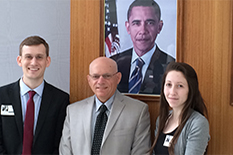
Regulatory Science Competition Winners Present Concepts to FDA
On Monday, April 28, University of Maryland (UMD) Fischell Department of Bioengineering (BioE) graduate student Chelsea Virgile and University of Rochester medical student David Brodell traveled to Silver Spring, Md. to present their respective award-winning “America’s Got Regulatory Science Talent” competition concepts to the Food and Drug Administration (FDA). First hosted in 2013 by the University of Maryland School of Medicine and the Center of Excellence in Regulatory Science and Innovation (M-CERSI), a collaboration with UMD, the “America’s Got Regulatory Science Talent” competition is designed to promote student interest in the science of developing new tools, standards and approaches to assess the safety, efficacy, quality and performance of FDA-regulated products. Virgile was named the winner of this year’s M-CERSI competition for her entry “Liquid Barcoding Pharmaceuticals for Counterfeit Pharmaceutical Drug Detection.” Advised by BioE Department Chair and Robert E. Fischell Distinguished Professor William Bentley, Virgile is a second year graduate student who has focused much of her recent research on synthetic biology and genetic engineering of E. coli as “smart” bacteria for detection and delivery of therapeutics. Her competition entry dovetails on the efforts put forth by Maryland spinout company, Diagnostic anSERS, Inc., whose technology incorporates inexpensive Surface Enhanced Raman Spectroscopy (SERS) approaches for the detection of a variety of molecules in the defense and drug industries. SERS, a molecular fingerprinting technique, is most often used to detect trace amounts of explosives, drugs, toxins or other target substances. “Counterfeit drugs are found not only in foreign countries, but in the United States as well,” Virgile said. “According to the Center for Medicine in the Public Interest, approximately 10 percent of drugs sold around the world are counterfeits, and these drugs generate an estimated $75 billion per year in profits for counterfeiters. “Since Diagnostic anSERS’ liquid barcoding technology works by adding a molecular barcode at ultra-low concentrations, counterfeiting of these markers would not be feasible,” she added. For the first time, in addition to M-CERSI's competition, an "America's Got Regulatory Science Talent" competition was also held at the University of Rochester Medical Center (URMC) as a component of their Regulatory Science educational initiatives, led by Drs. Scott Steele and Joan Adamo. Brodell's "Team Cardioid" was declared the winner for the entry, "Developing a High-Resolution 3D Heart Model for Drug Safety Assays." Brodell's proposal looks to improve the process of determining whether an experimental drug will be toxic to the heart through the use of advanced computational simulations. Advised by Dr. Jean-Phillippe Couderc, URMC is collaborating with researchers at IBM to better understand the mechanisms associated with drug-induced ion-channel dysfunction through work with a complex computer model of the human heart using the university's Blue Gene/Q supercomputer. Both Virgile and Brodell had the privilege of presenting their concepts to FDA Chief Scientist Dr. Stephen Ostroff, as well as other FDA staff members, at the agency’s White Oak campus.
May 5, 2014 Prev Next |