MSE Researchers Publish Series Study on All-Solid-State Batteries
Safety concerns have long been the Achilles’ heel of the Li-ion battery. Commercial Li-ion batteries use highly flammable organic polymer electrolytes, which have been responsible for the recent incidents of the Tesla Model S electric vehicle bursting into flames upon impact, as well as the massive recall of Samsung Galaxy 7 due to battery deficiencies.
UMD researchers are focusing on novel battery technology that is intrinsically safe and boasts higher energy density than that of the Li-ion battery. Replacing current organic polymer electrolytes with non-flammable ceramic solid electrolytes to assemble all-solid-state Li-ion batteries is crucial. Ceramic-based solid electrolytes never catch fire, and can ultimately solve the safety problems of Li-ion battery. Moreover, all-solid-state Li-ion batteries have the benefit of higher energy density, a high recharging rate, and a longer cycle life. Developing an all-solid-state Li-ion battery is imperative to next-generation technology for both portable electronics and electric vehicles.
Currently, one critical problem for the development of such technology is its elevated, interfacial resistance, which continues to limit battery performance. These material interfaces in batteries, however, are rarely understood – even the most advanced, experimental characterization has difficulty probing these obscure interfaces.
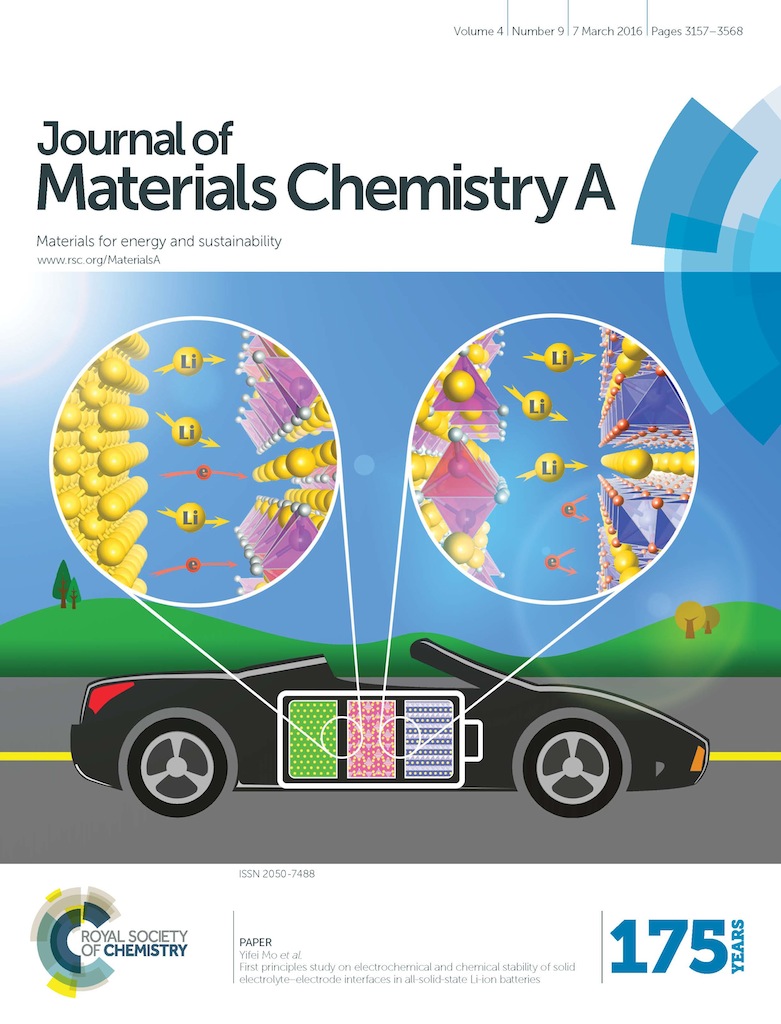
To overcome such difficulties, MSE Assistant Professor Yifei Mo is using state-of-the-art computational modeling to study these interfaces. Using UMD supercomputers, e.g. Deepthought2, quantum mechanical modeling of materials phenomena is performed to provide novel insights of the underlying problems. Additional strategies are frequently suggested in an effort to improve this new battery technology. Dr. Mo’s research has been published in a series of papers, and was featured on the cover of the Journal of Materials Chemistry A.
Associate Professor Chunsheng Wang (ChBE) and graduate students Yizhou Zhu (MSE), Fudong Han (ChBE) and Xingfeng He (MSE) have also contributed.
- Yizhou Zhu, Xingfeng He, Yifei Mo*, “First Principles Study on Electrochemical and Chemical Stability of the Solid Electrolyte-Electrode Interfaces in All-Solid-State Li-ion Batteries”, Journal of Materials Chemistry A, 4, 3253-3266 (2016). Cover feature.
- Fudong Han§, Yizhou Zhu#§, Xingfeng He#, Yifei Mo*, Chunsheng Wang*, “Electrochemical Stability of Li10GeP2S12 and Li7La3Zr2O12 Solid Electrolytes”, Advanced Energy Materials, 6, 1501590 (2016) (§ co first-authors)
- Yizhou Zhu, Xingfeng He, Yifei Mo*, “Origin of Outstanding Stability in the Lithium Solid Electrolyte Materials: Insights from Thermodynamic Analyses Based on First-Principles Calculations”, ACS Applied Materials & Interfaces, 7, 23685-23693 (2015)
Related Articles:
MSE Researchers Discover New Materials, New Research Direction for High-energy Li-metal Batteries
October 28, 2016
Prev
Next
|
|